Landing and Expanding Market Share for a B2B SaaS Company

B2B SaaS
Vertical Acquisition
12+ months, ongoing

TeamGantt came to us asking for Google Ads. They had strong SEO, a clear focus on construction as their highest-LTV vertical, and zero paid muscle. We took one look at what they actually had — and told them not to spend a dollar on Google Ads yet. The real opportunity was already signed up for a free trial.

Cost Per Demo
$42
Against B2B SaaS benchmarks that routinely run $150–$400+.
Demos Booked
400+
Sales-ready construction prospects, from a few remarketing campaigns.
Free Trials
1,811
New construction trials alongside the mid-funnel engine.
Purchases
230
Direct paid conversions over 12 months.

01
The Diagnosis

The brief was Google Ads. The real problem was the trial list they weren’t working.

TeamGantt’s SEO flywheel was doing its job. Organic trials were coming in, including a steady stream from construction — their highest-LTV vertical. The problem: every trial user got treated the same, regardless of industry. Construction users were being dropped into a generic onboarding, shown a generic product, and measured in a generic trial-conversion bucket. The cohort that mattered most was invisible in their own reporting.

A classic paid agency would have taken the Google Ads budget and spent it on new construction traffic. We looked at what was already there and saw something different. They had a construction-specific edition of the product that most of their construction trial users didn’t know existed. They had a cohort of high-intent signups sitting dormant after their trial ended. And they had no remarketing engine — not on Meta, not on YouTube, nowhere — to reach any of them.

Running Google Ads on top of that would have been spending money to find new strangers while the warm, signed-up, construction-identified prospects got ignored. So we told them no.
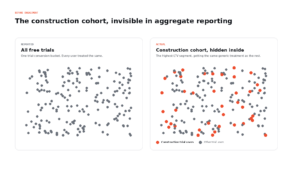
Fig. 01  ·   The high-LTV cohort hiding inside an undifferentiated trial list.
Before engagement

02
The Strategic Bet

From top-of-funnel acquisition to mid-funnel conversion.

Turn the construction trial users they already had into paid customers, instead of paying Google to find new ones. That was the shift. Everything else followed from it.

It came with a real tradeoff. We deliberately did not pursue net-new construction traffic for the first phase of the engagement. Given a limited budget, chasing cold prospects through search while ignoring a sitting list of warm ones would have been the wrong order of operations. We said no to the expensive thing first and earned the right to come back to it later.

The first thing a good strategist tells you is what not to buy. We told TeamGantt not to buy Google Ads yet — because the list they already had was the better asset.

— Our operating principle on this engagement

One early lesson reshaped the whole creative approach. We started out assuming free-trial users would remember TeamGantt and mostly need a nudge toward a demo. They didn’t. A free trial didn’t mean warm — it meant lukewarm, at best. We had to remarket to them as if they were half-learning about the product for the first time, while still respecting that they weren’t cold strangers. That single calibration showed up in every ad we wrote afterward.
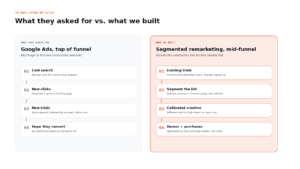
Fig. 02  ·   What they asked for vs. what we built.
The model, before any tactics

03
How We Executed

Four pillars, in a specific order.

The tactics a normal paid agency runs — custom audiences, creative, channel selection — aren’t unique. What’s unique here is the pillar that came before all of them. We didn’t write a single ad until we’d done the homework on what construction buyers actually objected to.

01
Pillar · Audience intelligence

Don’t guess at objections. Mine them.

Before we touched a creative brief, we went looking for real objections from real construction buyers. We triangulated across three sources: TeamGantt’s existing customer interview archive, their customer testimonial videos, and a structured questionnaire we ran across their full sales team. The patterns that emerged — “my crew won’t actually use it,” “I don’t want another tool on top of Procore,” “it’s going to be too complicated” — became the brief for every ad we wrote afterward.

  • Reviewed existing customer interviews for recurring objection patterns
  • Analyzed customer testimonial videos for the actual language buyers used
  • Ran a structured questionnaire across the full sales team to surface deal-blocking objections

02
Pillar · Audience building

One list isn’t an audience. It’s four.

Uploading the construction trial users as one undifferentiated custom audience would have missed the point. Not every trial user is the same distance from a real purchase. We split them by company revenue and by whether they’d indicated they use Procore — a sharp signal, because a Procore user has already bought into construction-specific PM tooling and has the budget for it. High-value cohorts got direct-response, book-a-demo creative. Lower-intent cohorts got warm-up content designed to pull them back into the product.

  • Uploaded construction-identified trial users as segmented Meta custom audiences
  • Split high-value cohort ($5M+ revenue, Procore users) from lower-intent cohort
  • High-intent audiences got demo-focused creative; lower-intent got re-engagement

03
Pillar · Creative strategy

Name the objection. Disrupt the scroll.

Every creative angle mapped to something the audience intelligence work had surfaced. The construction edition existed but trial users didn’t know about it — so we made the construction edition the hero of the ad. Adoption fear (“my crew won’t use it”) was the single most common objection — so we ran a disruptive ease-of-use campaign with a grandma in a hard hat on a construction site, with the line “so easy your grandma could use it.” On top of that, we layered MQL lead magnets built specifically for the vertical: punch list templates and an Ultimate Guide to Construction PM, both doing lead capture and category authority work at once. YouTube testimonials rounded out the mix with third-party credibility.

  • Construction-edition feature ads for trial users who never knew it existed
  • Disruptive ease-of-use creative built around the top adoption objection
  • Vertical-specific lead magnets: punch list templates and a construction PM guide
  • YouTube testimonial videos as third-party credibility at the top of the funnel

04
Pillar · Strategic channel mix

Narrow on purpose.

With a limited budget, spreading across LinkedIn, programmatic, and Google Display would have bought us shallow reach across five channels instead of full penetration on the one channel that actually matters for custom audiences. Meta is where custom audience remarketing works, full stop. We went deep instead of wide — and we fixed Meta’s conversion tracking to optimize against purchases, not clicks or trials, so the platform’s algorithm was chasing the right signal. Narrow, but correctly instrumented.

  • Meta as the primary remarketing channel, chosen for custom audience fidelity
  • YouTube for testimonial content layered on top
  • Meta conversion tracking rebuilt to optimize on purchases, not clicks or trials

04
The System We Built

A segmented remarketing engine that treats trial users differently based on how close they are to buying.

This is the artifact. Not a campaign. Not a creative set. A system that takes every new construction trial user, scores them against revenue and Procore usage, routes them into the right cohort, and shows them creative calibrated to where they are in the decision. Every stage has a measurement point. Every measurement point feeds the next decision.
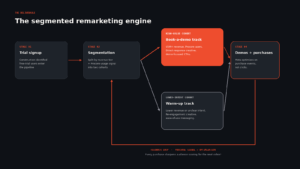
Fig. 03  ·   The segmented remarketing engine. Trial in, demo or purchase out.
The deliverable

05
Proof Of Work

Two ads doing two different jobs.

A creative portfolio from the engagement. The first ad is disruptive — it attacks the “my team won’t use it” objection head-on with a grandma in a hard hat. The second is a serious product-feature ad aimed at the higher-intent cohort that’s already past that objection and evaluating the tool. Same system, calibrated to where each viewer is.

Fig. 04  ·   Two live ads, calibrated to different cohorts.
Actual creative from the engagement
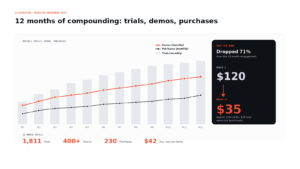
Fig. 05  ·   Demos, trials, and purchases over 12 months.
Illustrative, based on engagement data

06
What Changed

From zero paid infrastructure to a predictable construction pipeline.

TeamGantt went from no paid channel at all to a construction-specific acquisition engine driving demos, trials, and purchases at unit economics that beat typical B2B SaaS benchmarks by a wide margin. Twelve months in, they now have the mid-funnel conversion system working — which is why we’re finally expanding into net-new acquisition together.

$42
Cost per demo
In a category where paid B2B demos typically run $150–$400+. Sales started treating paid as a predictable source, not an expensive side channel.
400+
Demos booked
Sales-qualified construction prospects, from a focused set of remarketing campaigns — not a sprawling paid program.
1,811
Free trials driven
Net-new construction trials generated alongside the mid-funnel remarketing engine — the vertical’s pipeline, compounding.
230
Direct purchases
Paid conversions over 12 months, directly attributed to the system. The reframe paid for itself many times over.

The biggest benefit of working with Digital Trax is keeping your ads in sync across every platform. It’s one system, not five disconnected campaigns.

— TeamGantt leadership  /  placeholder, to confirm exact wording with client

07
Why This Engagement Is The Template

Most agencies run the brief. We run the diagnosis first.

A classic paid media agency would have taken the Google Ads brief and executed it. They’d have written ad copy, launched search campaigns, reported on click-through rates, and spent a year paying Google to find construction users. The warm trial list would have kept sitting there. The construction edition would have stayed invisible to the people already using the product. The reported numbers would have looked fine. The business problem — that the most valuable cohort in the building was being ignored — would have gone untouched.

What we did instead is what we do on every engagement: treat the brief as a hypothesis, not an instruction. The single thing that made this engagement work is the thing that happens before any paid agency would have started — the customer interviews and the sales team questionnaires. We didn’t guess at construction buyers’ objections. We mined them. Every ad we wrote afterward was anchored to something a real prospect had actually said.

If you’re evaluating agencies and every pitch sounds like a list of paid tactics, that’s because most of them are running the same playbook. The question worth asking isn’t which platforms will you buy on? It’s how will you tell whether the brief we wrote is the right brief at all?
Ready to talk?

Sitting on a list you’re not working? We should talk.

We start every engagement with a free marketing audit — same diagnostic lens we applied to TeamGantt. No deck. No pitch. A straight read on whether the paid program you’re about to launch is the one you actually need.

Book a Free Audit →

How We Cut CPL by 75%+ and Gained Full-Funnel Visibility

Home Services
Paid Acquisition
6 months

Winner Insulation wasn’t short on leads. They were short on answers. Their previous agency was reporting healthy conversions, but booked jobs weren’t keeping pace, cost per lead was north of $300, and nobody could explain why. Before we touched a single campaign, we asked a question their last agency never did: are we even measuring the right thing?

Cost Per Lead
$300 $75
A 75%+ reduction, sustained over the engagement.
New Channel
+1
Facebook added as a second acquisition source.
Funnel Visibility
0 → 100%
From click to scheduled job, in one system.
Engagement
6 mo.
To rebuild the measurement + acquisition system.

01
The Situation We Inherited

A dashboard full of green arrows, and a pipeline that didn’t match.

On paper, things looked fine. Form fills were coming in. Phone calls were ringing. Conversion rates were being reported. Underneath the dashboard, three things were broken at once — and no single fix would address any of them in isolation.

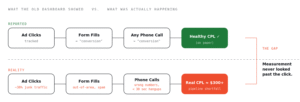
The previous agency had optimized the campaigns they were asked to run. What they hadn’t done — and what Winner Insulation didn’t know to ask for — was question whether the definitions of success were correct in the first place. A “conversion” was anything that triggered a tag. A “lead” was anyone who filled out a form or picked up the phone, regardless of whether they were a homeowner in the service area or a telemarketer calling about office supplies. Every number downstream of those definitions was, quietly, wrong.

Fig. 01  ·   The measurement gap we walked into.
Before engagement

02
Our Diagnosis

The problem wasn’t the media buying. It was the definition of a lead.

This is where most agency engagements don’t pause. The brief was “lower our cost per lead” — and a classic agency would have gone straight to bid strategies, ad copy tests, and new creative. We didn’t. We spent the first two weeks listening to phone calls, reading form submissions, and tracing individual leads through to the operations team.

The leads being counted weren’t the leads the business actually ran on. Roughly a third of tracked phone conversions were under 30 seconds — wrong numbers, hangups, robo-spam. Form fills were coming from outside the service radius. The dashboard was optimizing a definition of success that had no connection to whether a truck got dispatched.

Any agency can lower a cost per lead. The harder question — and the one worth paying for — is whether the thing you’re calling a lead is actually a lead.

— Our operating principle

That reframe changed everything downstream. If the measurement was wrong, no amount of campaign optimization would help — we’d just be making a broken system more efficient. So we made a call that cost us short-term win reporting but was the only honest way forward: tighten the definition of a lead, watch the numbers get worse before they got better, and rebuild optimization on top of a cleaner signal.

03
The Strategic Bet

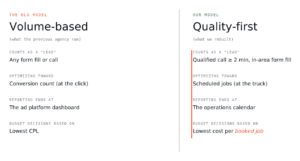
From volume-based lead generation to quality-first acquisition.

The strategy wasn’t tactical. It was a shift in what we were optimizing for.

Fig. 02  ·   The strategic shift that drove every tactical decision.
The model, before any tactics

04
How We Executed

Four pillars. Every tactic is a consequence of one of them.

The list of things a normal agency does — landing pages, call tracking, negative keywords — isn’t unique. What’s unique is why each one was done and how they were sequenced to reinforce a single thesis. Here’s how we grouped them.

01
Pillar · Redefine the signal

Stop counting the wrong things.

Before optimization could mean anything, we had to fix what we were optimizing for. We deployed call tracking with full recording, set a 2-minute minimum for a call to count as a conversion, and manually listened to enough calls to build a qualification rubric. The effect: the conversion metric stopped lying.

  • Call tracking and call recording across all paid channels
  • Conversion threshold raised to qualified calls ≥ 2 minutes
  • Manual QA of form fills to filter out-of-area and spam submissions

02
Pillar · Close the loop

Connect the click to the calendar.

A lead is only meaningful if you can follow it to a scheduled job. We built a centralized tracking system that let the operations team flag which leads actually booked, which channel they came from, and what service they wanted — then fed that signal back into campaign decisions every week.

  • Centralized lead-to-job tracking shared between marketing + ops
  • Weekly review cadence tying channel spend to booked revenue
  • Full-funnel visibility: click → call → qualified → quoted → booked

03
Pillar · Match message to intent

Every click lands somewhere it was promised.

Generic landing pages were dragging Quality Score down and telling searchers nothing specific. We built dedicated pages for each service, rewrote the value props around what actually differentiated Winner Insulation, and pruned search terms that weren’t going to turn into real jobs no matter what they cost.

  • Service-specific landing pages, one per offering
  • Differentiated value props replacing generic service copy
  • Ongoing negative keyword hygiene and search term review

04
Pillar · Diversify demand

Don’t let one channel decide the business.

With measurement fixed, we had the confidence to add a second acquisition channel without muddying the data. We introduced Facebook ads to reach demand outside of active search, held that traffic to the same qualification rubric, and gave Winner Insulation a hedge against platform-specific cost spikes.

  • Facebook as a second paid channel, held to the same quality bar
  • Creative tests anchored to the differentiated value props
  • Channel mix managed against booked jobs, not just CPL

05
The System We Built

From click to scheduled job, instrumented end-to-end.

This is the single most important artifact of the engagement — not a campaign, but a system. Every stage has a measurement point. Every measurement point feeds the next decision. Nothing stops at the ad platform.

Fig. 03  ·   The closed-loop system. Every stage has a measurement point. Every measurement point feeds the next decision.
The deliverable

06
Proof Of Work

What the inside of the engagement actually looks like.

Two of the most operational artifacts from this engagement. Most agencies show you decks. We’d rather show you the spreadsheet we live in every week and the line on the chart that matters.

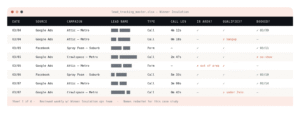
Fig. 04  ·   The shared lead tracker — where marketing claims get reconciled against the ops calendar.
Redacted excerpt

Fig. 05  ·   CPL trend over the engagement. The honest shape of a real turnaround.
Illustrative, based on engagement data

07
What Changed

The numbers, and what they meant for the business.

A result without a business meaning is just a statistic. Here are the numbers, each paired with why it mattered to Winner Insulation specifically.

−75%+
Cost per qualified lead
From $300+ to under $75. Marketing stopped being the expensive bottleneck and started being a predictable input.
100%
Funnel visibility
Every click now traces through to a booked job or an explicit reason it didn’t. No more black-box reporting.
Acquisition channels
Facebook added alongside Google Ads without introducing noise. A real hedge against platform volatility.
Weekly
Decision cadence
Budget moves are based on booked jobs by source, every week — not monthly CPL dashboards after the fact.

We came in thinking we had a cost problem. Digital Trax showed us we had a measurement problem — and fixing that fixed everything else.

— Winner Insulation leadership  /  placeholder, to confirm with client

08
Why This Engagement Is The Template

Most agencies optimize the campaign. We rebuild the system.

A classic agency would have taken the brief — “lower our CPL” — and run it. They’d have tested bid strategies, written new ad copy, maybe rebuilt a landing page. The numbers on the existing dashboard would have improved a little. The actual business problem — that the dashboard was lying — would have gone untouched.

What we did instead is what we do on every engagement: treat the brief as a hypothesis, not an instruction. Sometimes the brief is right and the work is execution. Often the brief is a symptom, and the real work is upstream of it. Knowing the difference is the entire job.

If you’re evaluating agencies and every pitch sounds the same, that’s because most of them are running the same playbook. The question worth asking isn’t what will you do? It’s how will you decide what to do?

Ready to talk?

If your dashboard looks healthy and your pipeline doesn’t, we should talk.

We only take on a handful of engagements at a time, and we start every one with a free marketing audit — same diagnostic lens we applied to Winner Insulation. No deck. No pitch. A straight read on whether your measurement is telling you the truth.

Book a Free Audit →

The ABA Therapy Growth Strategy That Was Counterintuitive

Steps Behavioral Health wasn’t struggling to get attention. They were struggling to earn trust. ABA therapy is a high-demand category — and a deeply damaged one. Parents weren’t comparing services. They were deciding who to believe. That’s not a media buying problem. That’s a credibility problem.

Monthly Enrollments
Consistent, high-quality
Predictable lead flow that converts to enrolled children — month after month.
New Markets
Counties & states
Expansion into multiple new counties and states, all fed by the same system.
Strategy Shift
Trust-first
Educational authority instead of direct-response ads.
Model
Repeatable
Same playbook works in every new market they open.

01
The Diagnosis

Parents weren’t comparing services. They were deciding who to believe.

ABA therapy sits in a painful market position: strong demand, broken trust. Families need the service. But the category has a reputation problem — inconsistent quality, churn, operators cutting corners — and parents have learned to be skeptical of anyone running ads.

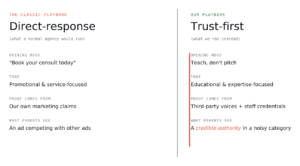
A standard agency would have looked at that and built a direct-response campaign — service pages, conversion-optimized ad copy, “book your consult today.” That’s what you do when the problem is awareness. But Steps didn’t have an awareness problem. They had a credibility problem. And you can’t ad-spend your way out of a credibility problem. You have to earn the trust first, on the market’s terms.

Fig. 01  ·   The market we walked into.
Before engagement

02
The Strategic Bet

Teach first. Pitch later.

We built a trust-first acquisition system. Instead of asking parents to convert immediately, we led with thought leadership, educational content, third-party credibility, and the depth of Steps’ own clinical team. The bet: a parent who trusts you before they’ve met you is a parent who enrolls — and refers.

In a category where everyone’s claims sound the same, the provider who stops making claims and starts teaching wins.

— Our operating thesis on this engagement

Fig. 02  ·   The strategic reframe.
The model, before any tactics

03
How We Executed

Most of what Steps needed already existed.

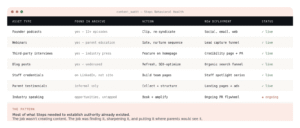
The unlock wasn’t more content. It was the content they already had — sitting in archives, unused. Old podcasts. Webinars from parent education sessions. Third-party interviews with their clinical leadership. Staff credentials buried on LinkedIn instead of the homepage. We ran an audit, found the gold, and built the engine around it.

01
Pillar · Revive the archive

Scale without new production.

Before we made anything new, we audited what already existed. Most of it was valuable. None of it was working — because it lived in the wrong places and none of it was structured to convert interest into inquiries.

  • Clipped and re-syndicated founder podcast episodes
  • Repackaged webinars into a gated lead-capture sequence
  • Refreshed and SEO-optimized blog posts that had gone stale

02
Pillar · Borrow outside credibility

Let other voices vouch.

In a market where every provider says they’re the best, the only claim that still carries weight is the one someone else makes about you. We leaned into third-party interviews, industry press, and external validation — positioning Steps as a voice others wanted to feature, not a brand doing its own PR.

  • Surfaced existing third-party interviews into a dedicated credibility hub
  • Booked leadership into industry speaking and guest content slots
  • Amplified every external mention as organic social + nurture content

03
Pillar · Put the team on stage

Credentials, not claims.

In trust-driven categories, the clinical team is the brand. We built out staff spotlights — real credentials, real experience, real faces — so parents could see exactly who would be working with their child. This was the single biggest differentiator against operators who hide behind a logo.

  • Built full team pages with credentials, backgrounds, and specialties
  • Staff spotlight series — ongoing, not one-and-done
  • Clinical leadership featured in ads, not just on bios

04
Pillar · Educate at the top

Warm the lead before the form.

At the top of the funnel, we stopped asking for conversions and started giving value. Education replaced promotion. Parents who found Steps through an article, a podcast, or a webinar arrived at the inquiry form already half-sold — because they’d already been treated like adults.

  • Top-of-funnel ads that taught, didn’t pitch
  • Content-led nurture sequences before any sales outreach
  • Measurement of engagement quality, not just click volume

04
The Engine

Every asset makes the next parent easier to convert.

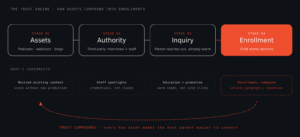
The four pillars stopped being four parallel projects and started being one compounding system. Content feeds authority. Authority warms inquiries. Inquiries convert to enrollments. Enrolled families refer. And every asset stays in circulation, quietly earning trust with the next parent who finds it.

Fig. 03  ·   The trust engine. Assets compound into enrollments.
The deliverable

05
Proof Of Work

We started with the audit.

Before we wrote a single new piece of content, we inventoried what Steps already had. Here’s a representative excerpt — and the pattern we found everywhere we looked.

Fig. 04  ·   The content audit that started the engagement.
Week 1 deliverable

06
What Changed

From a marketing problem to a growth engine.

Steps stopped competing on service promises and started winning on substance. The marketing became predictable. And once the model worked in one market, it worked in every market they opened next.

Fig. 05  ·   Consistent enrollments, then expansion.
Illustrative, based on engagement data
Consistent enrollments
Month after month
High-quality leads that convert into enrolled families — predictable enough to staff against, not just hope for.
Multi-state growth
Counties + states
The model became the expansion plan. Same content engine, deployed into each new clinic’s local market.
Better-fit parents
Not just more of them
Parents who came in via content were already aligned on approach — shorter sales cycles, higher enrollment rates, longer tenure.
Repeatable model
Works in every market
Trust isn’t local. The same authority-first playbook transfers cleanly from one county to the next.

07
Why This Engagement Is The Template

A classic agency would have missed the real problem.

The brief on most ABA marketing engagements reads the same: “drive inquiries, lower cost per lead.” Run that brief and you’ll build a direct-response campaign. You’ll get cheap clicks, a handful of skeptical form fills, and a client wondering why the enrollments aren’t keeping up.

What we did instead is what we do on every engagement: treat the brief as a hypothesis, not an instruction. Steps didn’t have a cost problem. They had a credibility problem. Different problem, different fix. And once you name the real problem, the tactics almost write themselves.

If you’re evaluating agencies and every pitch sounds like the same direct-response playbook, that’s because most of them are running the same playbook. The question worth asking isn’t what will you do? It’s how will you tell whether the brief is even right?

Ready to talk?

Running in a trust-broken category? We should talk.

We start every engagement with a free marketing audit — same diagnostic lens we applied to Steps. No deck. No pitch. A straight read on whether the brief you’re running is actually the right problem to solve.

Book a Free Audit →