
Steps Behavioral Health wasn’t struggling to get attention. They were struggling to earn trust. ABA therapy is a high-demand category — and a deeply damaged one. Parents weren’t comparing services. They were deciding who to believe. That’s not a media buying problem. That’s a credibility problem.
The Diagnosis
Parents weren’t comparing services. They were deciding who to believe.
ABA therapy sits in a painful market position: strong demand, broken trust. Families need the service. But the category has a reputation problem — inconsistent quality, churn, operators cutting corners — and parents have learned to be skeptical of anyone running ads.
A standard agency would have looked at that and built a direct-response campaign — service pages, conversion-optimized ad copy, “book your consult today.” That’s what you do when the problem is awareness. But Steps didn’t have an awareness problem. They had a credibility problem. And you can’t ad-spend your way out of a credibility problem. You have to earn the trust first, on the market’s terms.
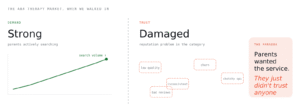
Before engagement
The Strategic Bet
Teach first. Pitch later.
We built a trust-first acquisition system. Instead of asking parents to convert immediately, we led with thought leadership, educational content, third-party credibility, and the depth of Steps’ own clinical team. The bet: a parent who trusts you before they’ve met you is a parent who enrolls — and refers.
In a category where everyone’s claims sound the same, the provider who stops making claims and starts teaching wins.
— Our operating thesis on this engagement
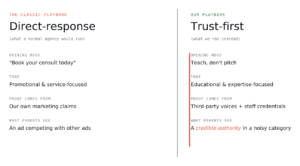
The model, before any tactics
How We Executed
Most of what Steps needed already existed.
The unlock wasn’t more content. It was the content they already had — sitting in archives, unused. Old podcasts. Webinars from parent education sessions. Third-party interviews with their clinical leadership. Staff credentials buried on LinkedIn instead of the homepage. We ran an audit, found the gold, and built the engine around it.
Scale without new production.
Before we made anything new, we audited what already existed. Most of it was valuable. None of it was working — because it lived in the wrong places and none of it was structured to convert interest into inquiries.
- →Clipped and re-syndicated founder podcast episodes
- →Repackaged webinars into a gated lead-capture sequence
- →Refreshed and SEO-optimized blog posts that had gone stale
Let other voices vouch.
In a market where every provider says they’re the best, the only claim that still carries weight is the one someone else makes about you. We leaned into third-party interviews, industry press, and external validation — positioning Steps as a voice others wanted to feature, not a brand doing its own PR.
- →Surfaced existing third-party interviews into a dedicated credibility hub
- →Booked leadership into industry speaking and guest content slots
- →Amplified every external mention as organic social + nurture content
Credentials, not claims.
In trust-driven categories, the clinical team is the brand. We built out staff spotlights — real credentials, real experience, real faces — so parents could see exactly who would be working with their child. This was the single biggest differentiator against operators who hide behind a logo.
- →Built full team pages with credentials, backgrounds, and specialties
- →Staff spotlight series — ongoing, not one-and-done
- →Clinical leadership featured in ads, not just on bios
Warm the lead before the form.
At the top of the funnel, we stopped asking for conversions and started giving value. Education replaced promotion. Parents who found Steps through an article, a podcast, or a webinar arrived at the inquiry form already half-sold — because they’d already been treated like adults.
- →Top-of-funnel ads that taught, didn’t pitch
- →Content-led nurture sequences before any sales outreach
- →Measurement of engagement quality, not just click volume
The Engine
Every asset makes the next parent easier to convert.
The four pillars stopped being four parallel projects and started being one compounding system. Content feeds authority. Authority warms inquiries. Inquiries convert to enrollments. Enrolled families refer. And every asset stays in circulation, quietly earning trust with the next parent who finds it.
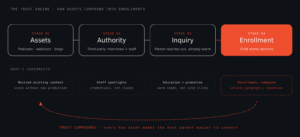
The deliverable
Proof Of Work
We started with the audit.
Before we wrote a single new piece of content, we inventoried what Steps already had. Here’s a representative excerpt — and the pattern we found everywhere we looked.
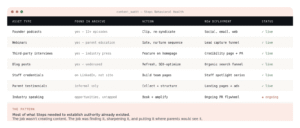
Week 1 deliverable
What Changed
From a marketing problem to a growth engine.
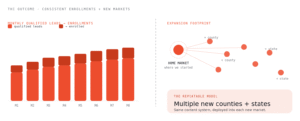
Steps stopped competing on service promises and started winning on substance. The marketing became predictable. And once the model worked in one market, it worked in every market they opened next.
Illustrative, based on engagement data
Why This Engagement Is The Template
A classic agency would have missed the real problem.
The brief on most ABA marketing engagements reads the same: “drive inquiries, lower cost per lead.” Run that brief and you’ll build a direct-response campaign. You’ll get cheap clicks, a handful of skeptical form fills, and a client wondering why the enrollments aren’t keeping up.
What we did instead is what we do on every engagement: treat the brief as a hypothesis, not an instruction. Steps didn’t have a cost problem. They had a credibility problem. Different problem, different fix. And once you name the real problem, the tactics almost write themselves.
If you’re evaluating agencies and every pitch sounds like the same direct-response playbook, that’s because most of them are running the same playbook. The question worth asking isn’t what will you do? It’s how will you tell whether the brief is even right?