
Vertical Acquisition
12+ months, ongoing
TeamGantt came to us asking for Google Ads. They had strong SEO, a clear focus on construction as their highest-LTV vertical, and zero paid muscle. We took one look at what they actually had — and told them not to spend a dollar on Google Ads yet. The real opportunity was already signed up for a free trial.
The Diagnosis
The brief was Google Ads. The real problem was the trial list they weren’t working.
TeamGantt’s SEO flywheel was doing its job. Organic trials were coming in, including a steady stream from construction — their highest-LTV vertical. The problem: every trial user got treated the same, regardless of industry. Construction users were being dropped into a generic onboarding, shown a generic product, and measured in a generic trial-conversion bucket. The cohort that mattered most was invisible in their own reporting.
A classic paid agency would have taken the Google Ads budget and spent it on new construction traffic. We looked at what was already there and saw something different. They had a construction-specific edition of the product that most of their construction trial users didn’t know existed. They had a cohort of high-intent signups sitting dormant after their trial ended. And they had no remarketing engine — not on Meta, not on YouTube, nowhere — to reach any of them.
Running Google Ads on top of that would have been spending money to find new strangers while the warm, signed-up, construction-identified prospects got ignored. So we told them no.
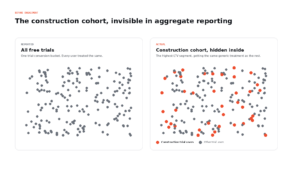
Before engagement
The Strategic Bet
From top-of-funnel acquisition to mid-funnel conversion.
Turn the construction trial users they already had into paid customers, instead of paying Google to find new ones. That was the shift. Everything else followed from it.
It came with a real tradeoff. We deliberately did not pursue net-new construction traffic for the first phase of the engagement. Given a limited budget, chasing cold prospects through search while ignoring a sitting list of warm ones would have been the wrong order of operations. We said no to the expensive thing first and earned the right to come back to it later.
The first thing a good strategist tells you is what not to buy. We told TeamGantt not to buy Google Ads yet — because the list they already had was the better asset.
— Our operating principle on this engagement
One early lesson reshaped the whole creative approach. We started out assuming free-trial users would remember TeamGantt and mostly need a nudge toward a demo. They didn’t. A free trial didn’t mean warm — it meant lukewarm, at best. We had to remarket to them as if they were half-learning about the product for the first time, while still respecting that they weren’t cold strangers. That single calibration showed up in every ad we wrote afterward.
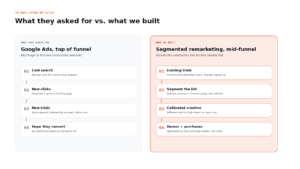
The model, before any tactics
How We Executed
Four pillars, in a specific order.
The tactics a normal paid agency runs — custom audiences, creative, channel selection — aren’t unique. What’s unique here is the pillar that came before all of them. We didn’t write a single ad until we’d done the homework on what construction buyers actually objected to.
Don’t guess at objections. Mine them.
Before we touched a creative brief, we went looking for real objections from real construction buyers. We triangulated across three sources: TeamGantt’s existing customer interview archive, their customer testimonial videos, and a structured questionnaire we ran across their full sales team. The patterns that emerged — “my crew won’t actually use it,” “I don’t want another tool on top of Procore,” “it’s going to be too complicated” — became the brief for every ad we wrote afterward.
- →Reviewed existing customer interviews for recurring objection patterns
- →Analyzed customer testimonial videos for the actual language buyers used
- →Ran a structured questionnaire across the full sales team to surface deal-blocking objections
One list isn’t an audience. It’s four.
Uploading the construction trial users as one undifferentiated custom audience would have missed the point. Not every trial user is the same distance from a real purchase. We split them by company revenue and by whether they’d indicated they use Procore — a sharp signal, because a Procore user has already bought into construction-specific PM tooling and has the budget for it. High-value cohorts got direct-response, book-a-demo creative. Lower-intent cohorts got warm-up content designed to pull them back into the product.
- →Uploaded construction-identified trial users as segmented Meta custom audiences
- →Split high-value cohort ($5M+ revenue, Procore users) from lower-intent cohort
- →High-intent audiences got demo-focused creative; lower-intent got re-engagement
Name the objection. Disrupt the scroll.
Every creative angle mapped to something the audience intelligence work had surfaced. The construction edition existed but trial users didn’t know about it — so we made the construction edition the hero of the ad. Adoption fear (“my crew won’t use it”) was the single most common objection — so we ran a disruptive ease-of-use campaign with a grandma in a hard hat on a construction site, with the line “so easy your grandma could use it.” On top of that, we layered MQL lead magnets built specifically for the vertical: punch list templates and an Ultimate Guide to Construction PM, both doing lead capture and category authority work at once. YouTube testimonials rounded out the mix with third-party credibility.
- →Construction-edition feature ads for trial users who never knew it existed
- →Disruptive ease-of-use creative built around the top adoption objection
- →Vertical-specific lead magnets: punch list templates and a construction PM guide
- →YouTube testimonial videos as third-party credibility at the top of the funnel
Narrow on purpose.
With a limited budget, spreading across LinkedIn, programmatic, and Google Display would have bought us shallow reach across five channels instead of full penetration on the one channel that actually matters for custom audiences. Meta is where custom audience remarketing works, full stop. We went deep instead of wide — and we fixed Meta’s conversion tracking to optimize against purchases, not clicks or trials, so the platform’s algorithm was chasing the right signal. Narrow, but correctly instrumented.
- →Meta as the primary remarketing channel, chosen for custom audience fidelity
- →YouTube for testimonial content layered on top
- →Meta conversion tracking rebuilt to optimize on purchases, not clicks or trials
The System We Built
A segmented remarketing engine that treats trial users differently based on how close they are to buying.
This is the artifact. Not a campaign. Not a creative set. A system that takes every new construction trial user, scores them against revenue and Procore usage, routes them into the right cohort, and shows them creative calibrated to where they are in the decision. Every stage has a measurement point. Every measurement point feeds the next decision.
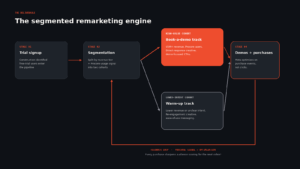
The deliverable
Proof Of Work
Two ads doing two different jobs.
A creative portfolio from the engagement. The first ad is disruptive — it attacks the “my team won’t use it” objection head-on with a grandma in a hard hat. The second is a serious product-feature ad aimed at the higher-intent cohort that’s already past that objection and evaluating the tool. Same system, calibrated to where each viewer is.

Actual creative from the engagement
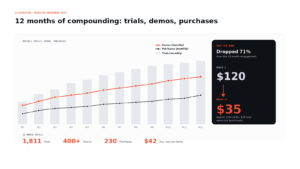
Illustrative, based on engagement data
What Changed
From zero paid infrastructure to a predictable construction pipeline.
TeamGantt went from no paid channel at all to a construction-specific acquisition engine driving demos, trials, and purchases at unit economics that beat typical B2B SaaS benchmarks by a wide margin. Twelve months in, they now have the mid-funnel conversion system working — which is why we’re finally expanding into net-new acquisition together.
The biggest benefit of working with Digital Trax is keeping your ads in sync across every platform. It’s one system, not five disconnected campaigns.
— TeamGantt leadership / placeholder, to confirm exact wording with client
Why This Engagement Is The Template
Most agencies run the brief. We run the diagnosis first.
A classic paid media agency would have taken the Google Ads brief and executed it. They’d have written ad copy, launched search campaigns, reported on click-through rates, and spent a year paying Google to find construction users. The warm trial list would have kept sitting there. The construction edition would have stayed invisible to the people already using the product. The reported numbers would have looked fine. The business problem — that the most valuable cohort in the building was being ignored — would have gone untouched.
What we did instead is what we do on every engagement: treat the brief as a hypothesis, not an instruction. The single thing that made this engagement work is the thing that happens before any paid agency would have started — the customer interviews and the sales team questionnaires. We didn’t guess at construction buyers’ objections. We mined them. Every ad we wrote afterward was anchored to something a real prospect had actually said.
If you’re evaluating agencies and every pitch sounds like a list of paid tactics, that’s because most of them are running the same playbook. The question worth asking isn’t which platforms will you buy on? It’s how will you tell whether the brief we wrote is the right brief at all?